SABER-Math
An Automated Reranking Benchmark for Mathematical Information Retrieval
As agentic AI systems tackle more complex mathematical tasks, they increasingly rely on information retrieval (IR) to search problem databases, theorem libraries, and educational resources. However, choosing the right retriever remains difficult, as it is infeasible to isolate its effect on downstream performance. On the other hand, existing retrieval-specific benchmarks often fail to capture fine-grained mathematical relevance, penalizing systems that retrieve useful documents. We address this gap with SABER-Math, the first fully automated reranking benchmark for mathematical IR, built without expert annotation. Starting from 283K high-school-level problems with solutions, it builds challenging tasks in three steps: (i) LLMs extract concise solution summaries and topics for each problem; (ii) candidates are discovered per query using ontology-based topic similarity and lexical overlap between solution summaries; and (iii) a Swiss-style LLM preference tournament assigns every candidate a graded relevance rating. Over these judged candidate pools, we evaluate retrievers across all major paradigms, from lexical and math-specific systems to modern embedding, late-interaction, and reranking models. Reasoning embedders lead, followed by general-purpose models, both far outperforming classical and math-specific baselines. Yet, all still struggle in symbol-heavy domains such as Algebra and Calculus. Importantly, we show that generic IR benchmarks, such as MTEB, track mathematical performance broadly but are less discriminative among the strongest models, highlighting the need for domain-specific evaluation.
Methodology
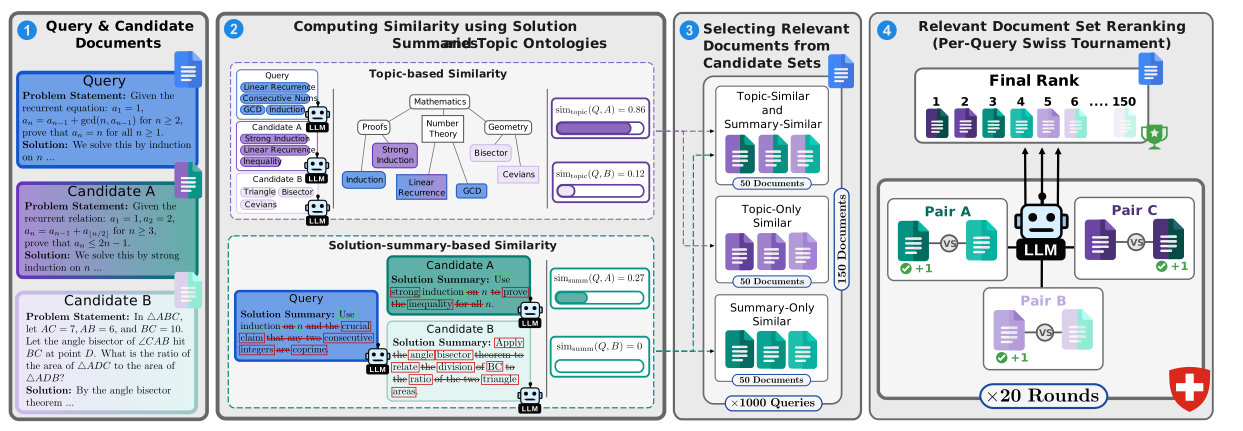
Figure 1. Query documents are shown in blue. Saturated purple denotes topic relevance, saturated teal denotes solution-summary relevance, and muted colors denote less relevant documents.
Results
{{ settingDesc }}
| Model | |
|---|---|
|
|
|
Accuracy against latency
Figure 2. Retrieval quality in the {{ settingPhrase }} setting against median latency per reranking task, served with vLLM at batch size B = 16, on a logarithmic time axis. One quality–latency frontier is traced at a time: red for single-pass retrievers (embedding, lexical and API models), black for rerankers and late-interaction models — use the toggle above to switch. A model is on its frontier when no model of the same kind is both faster and better. Hover a point for its name and values.
Score over time
Figure 3. Retrieval quality in the {{ settingPhrase }} setting against public release date. Models released before 2023 share the shaded band on the left. One state-of-the-art trace is shown at a time: red for single-pass retrievers (embedding, lexical and API models), black for rerankers and late-interaction models — use the toggle above to switch. A model is marked when it was the best of its kind available at its release.
Takeaways
Reasoning IR methods achieve the best results
Training on reasoning data is a strong factor for higher performance. ReasonEmbed-Qwen3-8B, RaDeR-7B, and Diver-4B outperform Octen-8B, the strongest general-purpose bi-encoder we evaluate, while being no larger than it.
Strong LLM backbones matter too
The Qwen and Llama versions of ReasonEmbed share a training recipe and a parameter count, yet differ by 0.046 on the strength of their backbone alone. The Llama-based ReasonIR-8B and the ModernBERT-based Reason-ModernColBERT both trail Qwen3-Embedding-4B despite being trained with reasoning data.
IR systems struggle more on symbolic tasks
For the strongest systems, Geometry and Combinatorics tend to be easier, while symbol-heavy domains like Algebra, Number Theory, and Calculus are more challenging. ReasonReranker-Qwen3-32B-Rewrite reaches 0.749 on Geometry and 0.783 on Combinatorics, but only 0.710 on Algebra.
Generic retrieval benchmarks cannot solely predict performance on mathematical IR
Correlations between SABER-Math and MTEB multilingual IR are 0.77 (Pearson) and 0.82 (Spearman), but drop to 0.62 and 0.73 for models released from 2025 onwards. Harrier-27B ranks 1st on MTEB while trailing the Octen, Gemini, and Qwen models here.
Cite
@inproceedings{georgiev2026sabermath,
  title     = {{SABER}-Math: An Automated Reranking Benchmark for
               Mathematical Information Retrieval},
  author    = {Georgiev, Nikolay and Drencheva, Maria and
               Ibragimova, Kseniia and Petrov, Ivo and
               Dimitrov, Dimitar I. and Vechev, Martin},
  booktitle = {The 2026 Conference on Empirical Methods in
               Natural Language Processing},
  year      = {2026},
  url       = {https://openreview.net/forum?id=Tb2EKLtAS0}
}